A Growing Market, but the Same Old Problem at the Edge
We are seeing steady growth in interior woodworking, outdoor decking, timber detailing, and wood structure projects. Owners want cleaner finishes. Contractors want faster installation. Purchasing teams want fewer callbacks, less waste, and more predictable fastening performance.
Yet one frustrating problem keeps showing up on jobsites: when a screw is driven too close to the edge of wood, the board often cracks.
Experienced installers usually know the workaround, pre-drill first. But pre-drilling adds steps, takes time, and slows down the crew, especially when the schedule is tight. In many trimming, jointing, and thin-board applications, moving farther away from the edge is not even an option.
In our view, this is not only a material problem. Very often, it is a screw design problem. That is exactly why we developed the EdgeFit Anti-Split Wood Screw.
Why Wood Splits Near the Edge?
Wood fibers weaken under lateral pressure
Wood is made of directional fibers. When a conventional screw enters near the edge, its thread geometry can force those fibers sideways. That outward pressure pushes the wood apart. The closer the screw is to the edge, the less material is available to absorb that stress. As a result, splitting becomes much more likely.
This is why near-edge fastening is widely considered risky, especially around a 5 mm edge distance. In practical terms, the installer is trying to secure a board in the exact area where the wood has the least resistance.
Why “just stay farther from the edge” is not a real solution?
On paper, staying farther from the edge sounds simple. On real projects, it often fails.
Typical problem situations include:
interior trim and finishing work
thin board joining
decking edge details
narrow framing members
space-limited woodworking assemblies
In these cases, the fastening point is dictated by the design, not by installer preference. The screw must perform where it is needed.
The Real Cost of Pre-Drilling
Pre-drilling is the traditional answer because it helps reduce splitting pressure before the screw goes in. But it comes with tradeoffs:
Issue | Impact on Jobsite |
Extra step | Slower installation workflow |
Additional tools | More setup and handling |
Labor time | Higher installation cost |
Misalignment risk | Hole position can affect finish quality |
Rush conditions | Crews may skip the step and accept higher failure risk |
For purchasing managers and project owners, this matters because labor efficiency is part of product performance. A screw that requires extra preventive work may reduce visible cracking, but it also raises hidden costs in time, crew coordination, and rework.
How the EdgeFit Anti-Split Wood Screw Works?
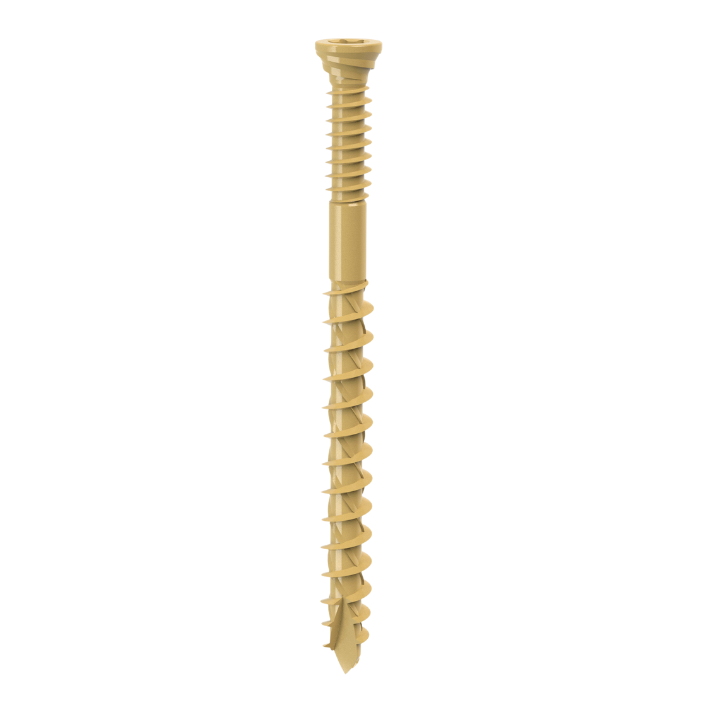
It is designed to reduce splitting stress during driving. The EdgeFit Anti-Split Wood Screw is engineered specifically for close-to-edge fastening in split-prone wood. Instead of forcing installers to rely on pre-drilling alone, the screw design itself helps reduce the stress that usually causes edge cracking.
According to the Fong Prean product page, the design includes:
1. Patented Slant Tip
The patented slant tip uses an angled cutting design to enter wood more smoothly and help reduce stress near the board edge. This is critical in the first stage of penetration, where traditional screws often begin to force fibers apart.
2. Twister Thread
The twister thread helps lower driving resistance and reduce wood stress during installation. Lower resistance means the screw can advance with less destructive pressure on split-prone material.
3. Top Thread
The top thread improves grip near the screw head and helps secure the wood more firmly for a more stable joint.
4. MS Trim Countersunk Head
The MS trim countersunk head helps create a cleaner, flush finish with less visible surface damage, which is especially valuable in exposed woodworking and finish applications.
What the 5 mm Near-Edge Test Proves?
Design matters more than size. One of the most useful takeaways from the Fong Prean EdgeFit product page is this: anti-split performance is not simply about using a smaller screw.
In the 5 mm near-edge test, a #8 standard wood screw caused visible splitting, while a larger #9 EdgeFit Anti-Split Wood Screw fastened at the same 5 mm edge distance with no visible edge splitting.
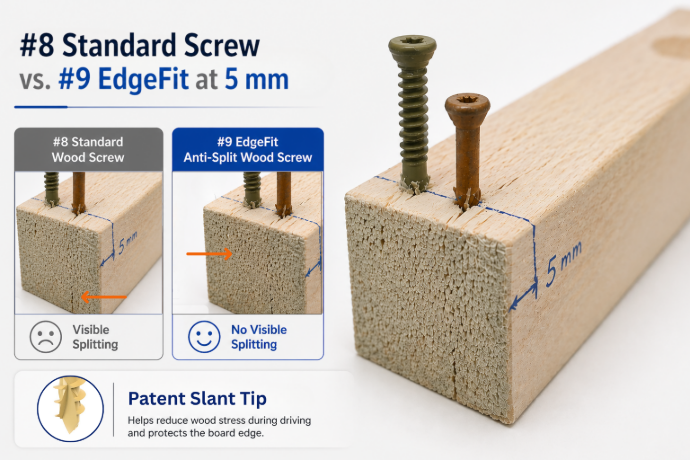
That result matters for buyers and specifiers because it shifts the decision away from guesswork. The key variable is not only diameter. It is the screw’s structural design and how it manages insertion stress inside the wood.
In short: if a larger screw with the right geometry can outperform a smaller conventional screw at the same edge distance, then screw design is the real differentiator.
Where This Matters Most?
The EdgeFit Anti-Split Wood Screw is especially relevant in the following applications:
- Outdoor decking and timber edges
Deck builders often fasten close to visible board edges where cracking leads to poor appearance, water entry risk, and premature board replacement.
- Interior trim and finishing
Clean edge conditions are essential in cabinetry, wall finishing, decorative woodwork, and detailed installation zones.
- Thin-board joining
When material thickness is limited, installers have little margin for error. A screw designed for edge protection reduces failure risk.
- Split-prone wood applications
Softwood, low-density wood, low-elasticity wood, and other crack-sensitive materials benefit from fastening systems designed to reduce lateral stress.
Quick Comparison: Conventional Screw vs. EdgeFit Anti-Split Wood Screw
Before choosing a screw for near-edge fastening, it helps to compare likely field outcomes.
Factor | Conventional Wood Screw | EdgeFit Anti-Split Wood Screw |
Near-edge risk | High | Reduced |
5 mm edge fastening | Commonly problematic | Tested for 5 mm near-edge fastening |
Need for pre-drilling | Often recommended | Can help reduce dependence on pre-drilling |
Surface finish | May damage visible edge area | Cleaner finish with trim countersunk head |
Rework risk | Higher | Lower potential risk in edge-sensitive applications |
FAQ: EdgeFit Anti-Split Wood Screw
1. Why does wood crack when I drive a screw near the edge?
Wood cracks because conventional screw threads can push wood fibers sideways. Near the edge, there is not enough surrounding material to absorb that lateral force, so splitting becomes more likely.
2. Is pre-drilling always necessary for near-edge wood fastening?
Pre-drilling is a common method to reduce splitting risk, but it adds time and labor. A screw specifically designed for near-edge fastening, such as the EdgeFit Anti-Split Wood Screw, can help reduce the need for extra preparation in many applications.
3. What is special about the EdgeFit Anti-Split Wood Screw?
Its anti-split performance comes from design features such as the patented slant tip, twister thread, top thread, and MS trim countersunk head, all intended to reduce stress, improve grip, and create a cleaner finish.
4. Can the EdgeFit Anti-Split Wood Screw fasten at 5 mm from the edge?
According to Fong Prean’s product information, the screw has been tested for 5 mm near-edge fastening and demonstrated better anti-split performance than a standard wood screw in that condition.
5. Is a smaller screw always safer near the edge?
No. The test result shown by Fong Prean indicates that design matters more than size. A well-engineered anti-split screw may perform better than a smaller conventional screw at the same edge distance.
6. What applications is this screw best suited for?
It is well suited for outdoor decking, indoor trim work, thin-board joining, and wood applications where edge splitting is a common installation problem.
A Smarter Choice for Buyers, Owners, and Installers
From our perspective, the real value of the EdgeFit Anti-Split Wood Screw is simple: it addresses a specific, expensive, long-standing problem at the point where conventional screws often fail.
Instead of accepting edge cracking as “normal,” buyers and project teams can specify a screw purpose-built for close-to-edge fastening. That means fewer damaged boards, less rework, less dependence on pre-drilling, and more consistent installation outcomes.
At Fong Prean, we have been developing fastening solutions since 1986, with experience in precision screw manufacturing, patented designs, and global supply support.
If you are evaluating fastening options for wood applications where edge cracking is a real concern, we recommend reviewing our EdgeFit Anti-Split Wood Screw in more detail. If you would like to discuss specifications, customization, or sourcing needs, please contact Fong Prean.