In the competitive landscape of modern construction and industrial manufacturing, "standard" is no longer enough. To meet specific project demands, builders and wholesalers are increasingly turning to Patent Screws & Customized Designs.
However, moving away from standard catalog items introduces a critical challenge: Compliance. How do you ensure a bespoke, high-performance fastener meets the rigorous safety requirements of international markets?
For procurement professionals, understanding the interplay between ISO, EN, and the crucial ETA (European Technical Assessment) is the key to mitigating risk while unlocking the benefits of innovation.
The Challenge: Balancing Innovation with Regulation
Sourcing Patent Screws & Customized Designs offers immense advantages—faster installation, higher pull-out strength, and tailored geometry. Yet, these innovations must still operate within the boundaries of global safety frameworks.
A customized screw that fails to meet regulatory standards can lead to project delays, legal liability, and costly recalls. Therefore, the Request for Quotation (RFQ) process must prioritize suppliers who can deliver both design flexibility and certified compliance.
Decoding the Standards: ISO, EN, and ETA
To validate the quality of customized fasteners, buyers must navigate three distinct layers of standards:
ISO (International Organization for Standardization):
- Focus: Global interoperability.
- Relevance: Defines the baseline for dimensions, threads, and mechanical properties (e.g., ISO 4014 for bolts). Even a customized screw typically starts with an ISO foundation.
EN (European Norms):
- Focus: Regional safety and environmental mandates for the EU.
- Relevance: Includes critical regulations like EN 14592 for timber structures, ensuring fasteners meet strength requirements specifically for wood construction.
ETA (European Technical Assessment): The Gold Standard for Innovation
- Focus: Performance verification for non-standard or innovative products.
- Relevance: This is vital for Patent Screws. If a product has a unique design that isn't fully covered by a harmonized standard, an ETA provides the technical basis required to support CE marking for construction products that are not fully covered by a harmonized EN standard. It is the ultimate endorsement of performance and safety for construction products in Europe.
Comparison Table: Which Standard Matters When?
| Standard |
Scope |
Example | Procurement Focus |
| ISO |
International |
ISO 4014 (Dimensions), ISO 898 (Properties) | Baseline Quality: Ensures basic fit and function globally. |
| EN | European Union | EN 14592 (Timber Structures) | Market Access: Mandatory for structural safety in the EU. |
| ETA | Technical Assessment | ETA-12/0266 (Wood Construction) | Innovation Validation: Proves that a customized/patented design performs as claimed. Essential for high-end construction. |
The Value of "Patent Screw & Customized Design"
Why go through the trouble of sourcing customized or patented fasteners? Because they solve problems that standard screws cannot.
- Customized Design: Allows engineers to request specific thread pitches, head styles, or coatings (like Ruskin coating for corrosion resistance) to match a project's unique environment.
- Patent Features: Innovations like knurled threads or special cutting points can significantly reduce installation time in typical applications, depending on material and installation conditions.
Success Case: The Twister Wood Screw
A prime example of this "Innovation + Compliance" synergy is the Twister Wood Screw by Fong Prean. It features a patented design for rapid insertion and reduced splitting. Crucially, it is backed by ETA certification, offering builders the assurance that its customized high-performance features are fully verified for structural use in the European market. Explore the ETA-certified solution here: Fong Prean Twister Wood Screw
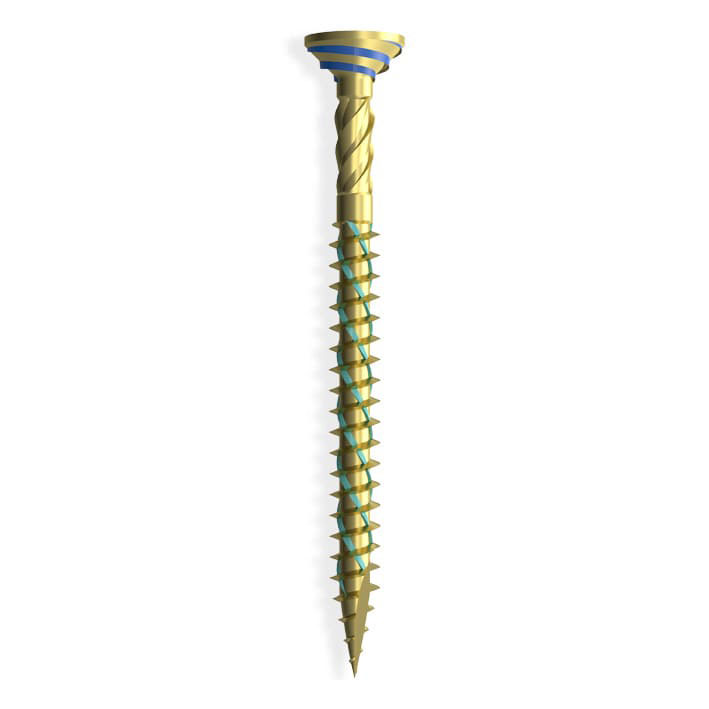
MS Twister Timber Screw
Procurement Advice: A Workflow for Customized Sourcing
When issuing an RFQ for customized fasteners, follow this workflow to ensure safety and quality:
- Define the Application: Is it for structural timber? If yes, specify ETA requirements early in the design phase.
- Verify Supplier Capabilities: Choose an OEM/ODM partner who understands not just manufacturing, but certification. Can they assist in obtaining ETA or CE marking for your customized design?
- Check the "DNA": Ensure the customized product still adheres to foundational ISO/EN material and dimensional standards where applicable.
- Request Documentation: Always demand the DoP (Declaration of Performance) and ETA reports before finalizing the order.
Conclusion
In the era of specialized construction, Patent Screws & Customized Designs are essential for efficiency and performance. However, innovation must never compromise safety.
By aligning procurement strategies with ISO, EN, and ETA frameworks, businesses can confidently source bespoke solutions. Partnering with experienced manufacturers like FONG PREAN—who offer both robust OEM/ODM capabilities and certified products like the Twister Wood Screw—ensures your supply chain remains innovative, compliant, and globally competitive.
Fong Prean’s Commitment
We specialize in transforming complex requirements into certified reality. From customized designs tailored to your blueprints to patent screws backed by international certifications (including ETA and CE), we provide the technical depth your projects demand.
- Need a Customized Screws or Patent Screws solution? Contact our technical consultants today.